Dear Soviette: Should I make a documentary?
A long answer to a simple question

It occurred to me recently that some of my most life-altering reads have been a glorified series of advice columns. While sick with norovirus (?) in Chicago, I picked up my friend C’s old copy of Rainer Maria Rilke’s Letters to a Young Poet and immediately read 45 pages. About 12 years ago, during another intense transitional phase (Jupiter return! my Dragon year! Astrologically significant in both Chinese and Indo-European astrological calendars!), I read Cheryl Strayed’s Tiny Beautiful Things (a collected version of her “Dear Sugar” advice column for The Rumpus) several times over, and saved a PDF onto my Google Drive for easy access.
Last week, my friend L reached out via email with a seemingly-simple question, possibly without realizing the can of worms they have invariably opened. (Freudian slip: I wrote “can of words” before realizing my mistake…) It’s a question I get a lot as a documentary scholar, and my opinions on the topic have evolved in the last few years, and actually relate a lot to my own work. So, I had a lot to say. I was also kind of touched because I think it can be very vulnerable to just flat out ask advice over email, which made me respond very carefully. I thought about it for about a day and then slowly compiled my thoughts together into something halfway coherent. In the end, both they and I were happy about the result so I decided to post a gently-edited version of the response here.
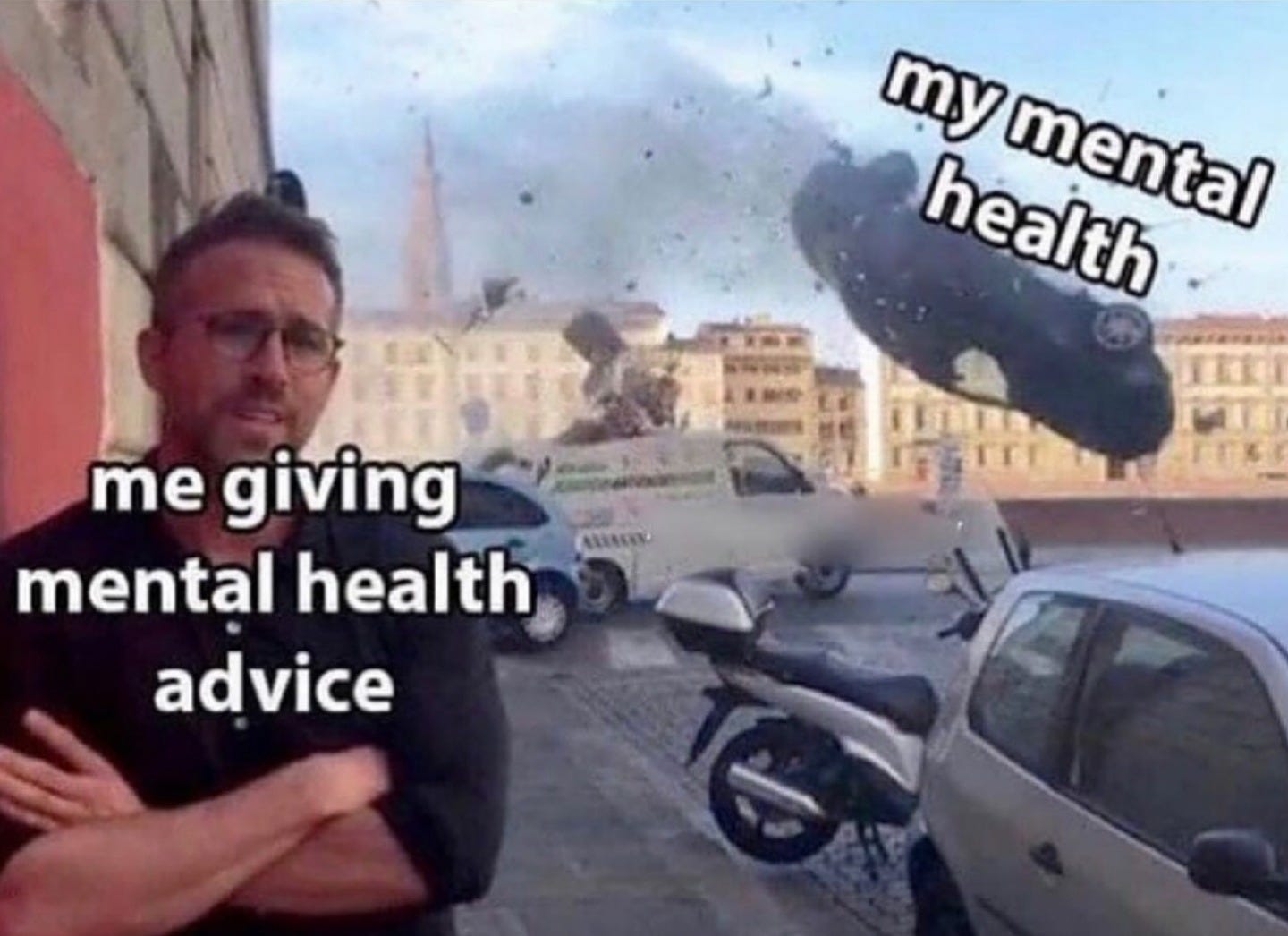
It occurred to me that other people reading this might have things they’d like to ask that pertain to their own life decisions, artistic practice, political commitments, anxieties or worries, etc. So, I decided to put up an anonymous Google Form which I’ll check about once a week or so. I have no idea whether this will come out to anything, or if anyone will ask any questions, especially since: a) my life is nowhere near perfect, and b) I am not a professional advice-giver or mental health expert. This meme feels incredibly accurate:
That said, I used to have students walk into my office to chat about all kinds of life problems, and now that my office is out of commission for the next short while (long story), I’ve really missed them. So, consider this Prof J’s Office Hours, Substack Edition.
Without further ado:
Hey, random question for a film studies scholar, how hard is it to make a good documentary? I met a friend of X [person L has been researching], and he was like, you should make a documentary, and I was like ok, maybe I will. Now I'm kinda obsessed with the idea. Any resources you can recommend? Is it possible to make a movie about X that isn't boring AF?
[Follow-up question, also related:]
How can I be careful and do it “right,” doing justice to X, etc?
Hey! Not a random question at all. But a hard to answer one! I’ll answer #1 first.
Short answer: Making a documentary is challenging, and time-consuming, and possibly won't even lead to anything, but you should totally 100% do it.
Long answer: I get this question a lot actually, since I think "making a documentary" is shorthand for people to mean "I want to teach someone something and no one reads anymore." So, lots of people make documentaries who don't actually know j***s*** about film (or documentaries), make something mediocre at best, it gets no distribution, the world continues. On the other hand, there are people who go to film school, still think documentaries need to educate or inoculate an idiotic audience with some kind of objective "truth," they spend lots of money on a degree that teaches them filmmaking, they make something, again, mediocre at best, it get some distribution, the world continues. This is largely because the history of documentary production is uniquely complicit with the state apparatus. See: Leni Riefenstahl, see: Frank Capra, etc.
Which doesn't mean we should not make documentaries! But, as Jill Godmilow wrote in the title of her book from a few years ago: perhaps we should Kill the Documentary? (The book itself is a fast and easy read). As someone very much ensconced in the documentary studies community, I am increasingly of the opinion that everyone should make documentaries, all the time. And, possibly, the less you know about filmmaking, the better. My friend Andrew Philip just presented on this, actually, in Melbourne at the Visible Evidence conference— he's a fantastic documentary filmmaker and spent many years learning the trade of commercial film and animation, but he had to "unlearn" many rules of documentary filmmaking in order to make a uniquely emotionally resonant and e/affective film. This was We Tattooed Your Mother (2023), which I hope will get a lot more international distribution. I also heard something similar from Contessa Gayles, an extremely talented filmmaker I went to college with— she spent years learning how to make documentaries after getting a journalism degree, made a bunch of solid ones for CNN (including about the 2017 Women’s March), but then had to "unlearn" a lot of these sometimes written/sometimes unwritten rules in order to make the abolitionist poetic documentary Songs from the Hole, which then went on to win a ton of awards (including the BlackStar Jury prize! 13 festival and industry wins, by last count!) and can change the world in a way that CNN documentaries could never.
Of course this doesn't mean that you should make something that looks bad. Honestly as long as you have a good sound editor, that's really half the battle— for me, sound is where a lot of otherwise fascinating films tend to look really amateurish in a bad way. Many people can be very good editors, and often there's a je-ne-sais-quoi quality of editing and cinematography that's just, "if you have it, you have it." And you probably have "it," whatever "it" is! So, I would say, just jump in and see what feels good. You'll always regret not doing it, and if there's something that pushes you toward it, just follow the fun (and as soon as it stops being fun, you can put it away for a while). Don't worry about fundraising or anything like that (for now). Our phones and Adobe Premiere (or iMovie, or Final Cut) are plenty, honestly, and I've seen great films made with much less. Some of the best documentaries in the history of cinema were made with $100k. Some with $10k. Some with less.
(This doesn’t mean you shouldn’t try to fundraise. Hell, if you can milk some money from a willing non-profit, go for it! We live in a capitalist hellscape! Gofundme your way to artistic freedom! But don’t think you necessarily need a lot of money to make great art. Too much money tends to sway politics in a certain direction, and you may start losing editorial control.)
Don't worry about it being boring. The less bored you are, the less boring it will be. Even the shittiest, most amateurish documentary about X is still infinitely more interesting than any documentary in Netflix or HBO Max or Go or whatever it calls itself these days, because it's weird and it’s interesting and it’s clear that the director was having an absolute ball. Makes me think of this comic ReelPolitik by the cinephile cartoonist Nathan Gelgud, kind of like if Godard’s characters from La Chinoise worked at a movie theatre and took it over:

One of the characters who is a kind of witch (?) travels to another planet and sees how in a Utopian alien society all the aliens made "amateur" films, all the time. So I'd say, be like the aliens and the Nike ads and just do it. If you need some cool stop-motion art or want to collaborate on something, I'd be happy to pitch in.
As to the follow-up question, which is about doing it “right.” I wanted to send along some resources because the question of doing it “right” is a little different from doing it at all. First off: I don't think only someone of a certain community should make a documentary dealing with said community. Some of the absolute best films about the Black Panthers were made by a Swede (Göran Olsson) and a Frenchwoman (Agnes Varda), so...
But! I do think it might be good to read up on the history of ethnographic methods. There's a lot to criticize about ethnography—Jay Ruby writes a lot about this and his writing is great on this topic— but generally the overly “objective” or scientific route is where things start getting bad and extractive. I think it might be good to look into the concept of “participatory documentary.” Bill Nichols invented this term, and his Intro to Documentary volume talks about participatory documentaries and their history in a really good way. Really, any doc with interviews is participatory, but the history of this mode is also one of collaboration (see: Jean Rouch, although his work is also problematic), and if there's a way to work with, or alongside, or nearby a community, it's in this mode. Trinh T. Minh-ha's work on documentaries “next to” or “alongside” are great in this regard, and her piece “The Totalizing Quest for Meaning” is one of my favorite writing pieces of all time and my students are consistently befuddled by it. But it’s so good! (Although her film Reassemblage works a little better in theory than practice, I think...)
In the past few weeks, I’ve also been thinking a lot about the value of documentary-making, or filmmaking, or artmaking writ large in a time that feels so terrifying and apocalyptic. Jill Godmilow has a great reminder on page 28 of Kill the Documentary: “In times of distress like ours, culture is not a luxury but a life raft.” Art is what makes life bearable, or worth living at all. But films aren’t escapist, either— or at least not the films we should be making (with apologies to Caitlin Benson-Alcott’s apologia for escapist film from 2020!). Documentaries should unmoor us, should produce what Godmilow describes as “uncommon wisdom” on p34:
That is the heart of the matter: to produce a witness who can receive uncommon wisdom. The goal of the postrealist film is a witnessing at the highest level of perception.
It’s strange. Documentaries are so often used to firmly ensconce our consciousness in the ideological structure of a certain period, that it becomes even more of an imperative to use nonfiction against itself. How else to imagine another world if not to use art to build the tools for this strange and terrifying freedom? What other medium is better for, as Luis Buñuel would have it, shocking the viewer out of their bourgeois optimism?
I hope you make your documentary. I hope we all do.