

For what, Soviet?
Notes on method, Slavic Studies, and what the 1920s means for us today

A version of this talk was delivered at the 11.22.2025 ASEEES conference in Washington, DC
The logo for ASEEES, the largest international conference of Slavic, East European, and Eurasian Studies, features two-thirds of a circle intersecting the top of an acute triangle, both perched at a jaunty angle. The bottom of the circle darkens where it overlaps the triangle, evoking an analog composite layering or collage.
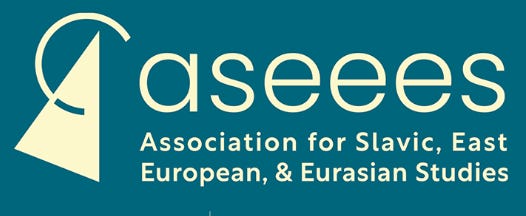
The image evokes many things: a sundial, an hourglass; a spotlight; an eye; a metronome. But the real heads know the obvious: that this image is an explicit reference to El Lissitzsky’s “Beat the Whites with the Red Wedge” from 1920, a constructivist propaganda poster created as visual embodiment of the Civil War that pinned the Bolsheviks against the White Army, a hodgepodge of capitalist and imperial forces opposing the 1917 Revolution.
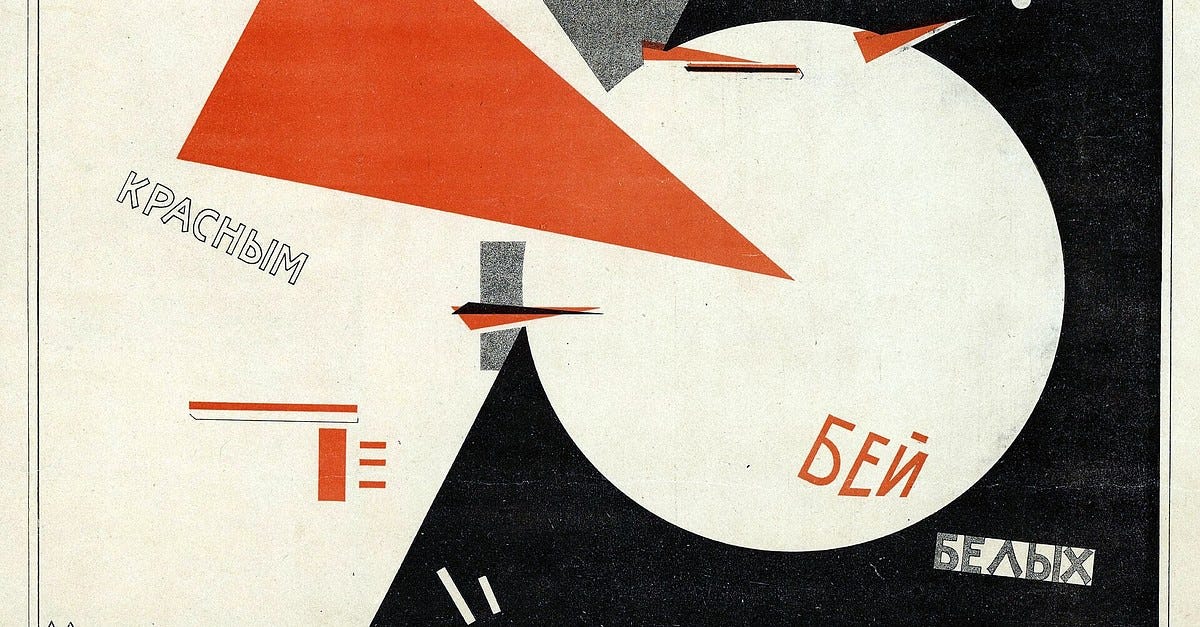
I’ve been staring at this ASEEES logo for years, marveling how a field that, at least since my first ASEEES conference over a decade ago, embodies so much Cold War ideology, can use the iconography of an uncompromisingly radical Jewish Bolshevik. Of course ASEEES is not the only organization to employ the quintessentially early Soviet iconography of the triangle and the circle, whose interlocking shapes evoke a sickle. Alan Birnholz wrote in ArtForum:
A red triangle, symbolizing the vigorous, assertive forces of the Revolution, breaks apart a lethargic counterrevolutionary white circle, as secondary skirmishes go on above and below. The meaning of these nonobjective forms is underscored by the words, placed on diagonals and varied in tone, color, and scale to enhance the overall dynamism of the composition.1
Yet there is something about this description that is lacking, that doesn’t approach its ubiquity in contemporary culture. It is as if the print became leftist advertising— or rather, advertising for leftism— par excellence, used to advertise everything from Verso (I gleefully picked up a tote bag advertising the iconic publisher with the Lissitzky print in 2017), conferences around artmaking and politics (including the Radical Film Network [RFN] or the Association for the Study of the Arts of the Present [ASAP], events organized by the Democratic Socialists of America (DSA), film screenings, etc— the list goes on. Apparently the way to formally symbolize and affectively convey the feeling of what it means to be radical— whose definition means grasping at the root, to literally uproot— is a dynamic combination of sickle-like circles and triangles, with everything always at an angle, implying something in motion, fundamentally dynamic and energetic, rather than stable and solidly moored. (And this, by the way, is not my invention but that of the Suprematists, especially Kasimir Malevich, who was Lissitzsky’s teacher and mentor in the formerly Jewish town of Vitebsk [more on this in a 2018 graphic essay I published in Jewish Currents2] ). It is as if looking at the shapes literally causes some kind of affective, energetic, precognitive sensation, or oщущение (oshchushchenie), described, in Emma Widdis’s words:
…[W]hen the relationship between body, mind, and matter was a subject of intense preoccupation. Defined by Vladimir Lenin himself in “Materialism and Empirio-criticism” (first published in 1909, and re-published in Moscow in 1920) as “the direct connection between consciousness and the external world,” oshchushchenie was a key term in early Soviet psychology. In Lenin’s much-quoted phrase, it was “the transformation of the energy of external excitation into a state of consciousness.”3
I mention this logo, and the affect it evokes, and the period it embodies, not because I am a fan of close visual analysis— or not just because— but because it identifies one example of the concrete way the Soviet 1920s continue to have a stronghold on visual representations of leftism worldwide. I, and I believe countless others, including many of us, are interested in the early years of the Soviet Union because they describe a profound and unceasing investigation into the way politics and feeling intersect— which is also why Lissitzky and his ilk are especially useful in the domain of leftist advertising, and our own (arguably, much more milquetoast) variety of 21st century socialist agit-prop.
My book Antifascism and the Avant-Garde: Radical Documentary in the 1960s, which came out February of this year from UC Press, is deeply invested in this question, specifically the intersection of feeling and radical politics. It describes how radical filmmakers— and by radical, I mean anticapitalist, communist, antifascist— aimed to mobilize an uncomfortable yet pleasurable and energizing affect in documentary to lead to revolutionary awakening in their viewers. Lissitzky is not really investigated but avant-garde documentary filmmaker avant la lettre Dziga Vertov reigns supreme, even though the book is almost exclusively an analysis of France and Japan in the 1960s. Some filmmakers I analyze— Jean-Luc Godard and Chris Marker are the clearest examples of this— think about Vertov as a kind of prophet (in the words of Serge Daney) whose techniques they are explicitly trying to emulate; others, such as Japanese filmmaker Matsumoto Toshio, were frequently described in relation to Vertov despite the artist themselves rarely referring to him at all (more on this in an extremely academic article I wrote last year4). The point is less influence than a dialectic of feeling and politics, the individual and the collective, also described by Raymond Williams as “structures of feeling.”
I find the methodologies of this field deeply inspiring and relevant, in the same ways contemporary leftist agitational propagandists might look back to Vertov and El Lissitzky and find a certain “structure of feeling” that elicits some indeterminable Soviet-coded affect: some odd combination of hope, the joy of being-in-community, and righteous anger. Yet my book isn’t ensconced in any one Area Studies domain, and isn’t eligible for awards at this very conference. Why, then, go to ASEEES? I find myself returning this conference every year, year after year, despite probably having more practical considerations for going to an Asian Studies conference, or the Society for Cinema and Media Studies conference, currently being boycotted. Yet ASEEES was more foundational to my book than any other educational or academic event. I frequently think about the ASEEES conference in 2020, when I was asked to join a roundtable by Rossen Djagalov, as part of a series of panels that would one day become the Black Sheep Society, which currently has over 500 members. Exhausted, overworked, lonely, and in the middle of intense and burnout-inducing organizing within Philly-DSA, I could only muster up some thoughts about affect and collectivity, and critiqued Affect Theory as a way of thinking through leftist filmmaking practices. Many of my colleagues in this room immediately suggested that I read many of the works described here— by Widdis, Williams, plus Lilya Kaganovsky, Josh Malitsky, and others who have similarly become close friends and interlocutors in the intervening years.
The next year, the first “post-”pandemic ASEEES in New Orleans, I joined another proto-Black Sheep panel (by now it was called the Socialism or Barbarism stream), this time on Literature, Cinema, and Antifascism. Although I didn’t immediately think of Vertov’s work as necessarily “antifascist,” I hurriedly trying to put together a cogent analysis. And then I had one of many “eureka!” moments in the process of writing my book: it really is all about antifascism, stupid! And thus the idea of antifascism lodged itself in my mind, becoming more coherent 6 months later when I actually started putting proverbial pen to proverbial paper.
The Black Sheep society, then, was integral for the creation of this book that is spiritually, if not formally, a component of this strange, Frankenstein’d, yet capacious and exciting area studies field. An avenue for potential future study is the connection between the early Soviet years and what became known as post-structuralism, a genealogy that stretches from the Russian formalists (Shklovsky, Eikhenbaum) to Jakobson, to structuralism (Roland Barthes etc), to post-structuralism— indeed to Critical Theory as such, as Fred Jameson describes in Years of Theory.5 This, however, is a thought for another time. What I hope to argue is that its roots are beyond mere geography or even influence. I hope that we can continue to push the field forward, through and beyond its stated boundaries— perhaps producing exciting connections at the vanguard of what used to be called “cultural studies” —even while it struggles for legitimacy within institutional frameworks during an increasingly anti-intellectual age.

Emma Widdis, Socialist Senses: Film, Feeling, and the Soviet Subject, 1917-1940 (Bloomington: Indiana University Press, 2017), 5-6.
Julia Alekseyeva, “Vertov and the Avant-Garde Documentary in Japan: Dreaming Reality in the 1960s” Film History (Vol 35:2, pp1-25, June 2024).
Fredric Jameson, The Years of Theory (London: Verso, 2024)