

Interview with the Graphic Memoir Blog
Sat down with Jonathan Sandler to talk about the making of Soviet Daughter

A little awkward to post your own interview/write-up not written in your own voice, but oh well! Appreciated the opportunity, despite how weird it is to talk about something I wrote (checks proverbial watch) 13 years ago? 😵💫
—
Why This Book?
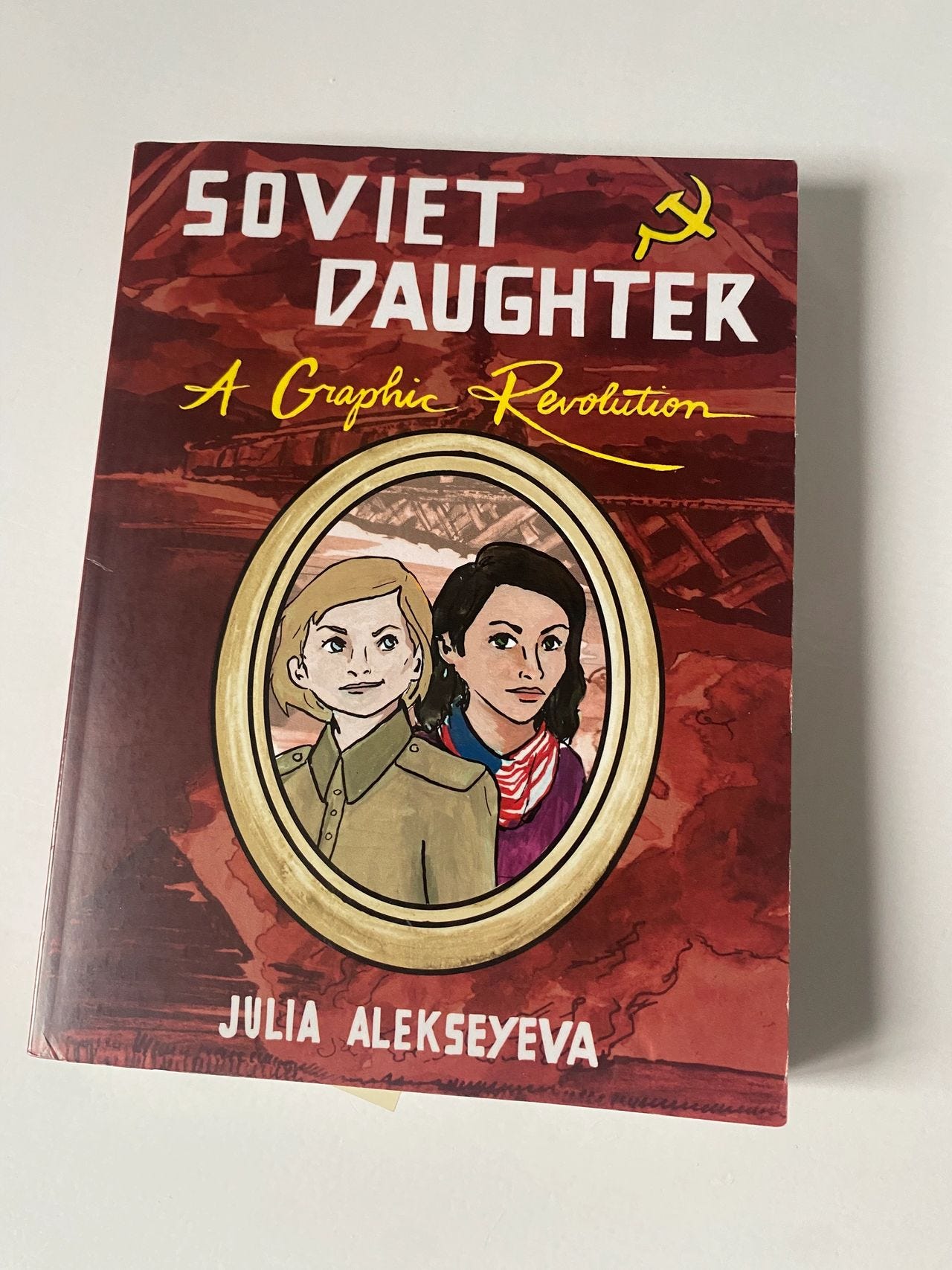
The project began in 2010, following the death of Julia’s great-grandmother, Lola. Julia was handed a stack of loose-leaf papers: Lola’s memoir, written in Russian and later typed into a 66-page document.
“It was that summer when I first read the loose-leaf sheets of paper where she wrote down her memoirs,” Julia recalled. “I read it with her daughter, Tanya, who is also in the book, and so we read it together.”
As she was starting her PhD, Julia knew the story felt too vital—and too visual—to remain as text. “I thought, this absolutely needs to be a graphic novel.”
Julia had been drawing since childhood, taking free classes at the Art Institute of Chicago, which she says “saved my life a lot of times.” Even while pursuing a PhD in Comparative Literature at Harvard University, the urge to create never left her.
A Focused Year
Three years into her PhD, Julia realised that academia and a graphic novel were competing for the same energy. She made a disciplined leap of faith: a 14-month hiatus from June 2013 to August 2014 to focus entirely on the book.
Because the script was already complete, she treated the period like a full-time job, producing roughly one page a day. Each page involved blue-pencil sketching, ink wash, and final inking. By the end, she had a complete manuscript (later published as a 192-page book).
Influences from the Avant-Garde
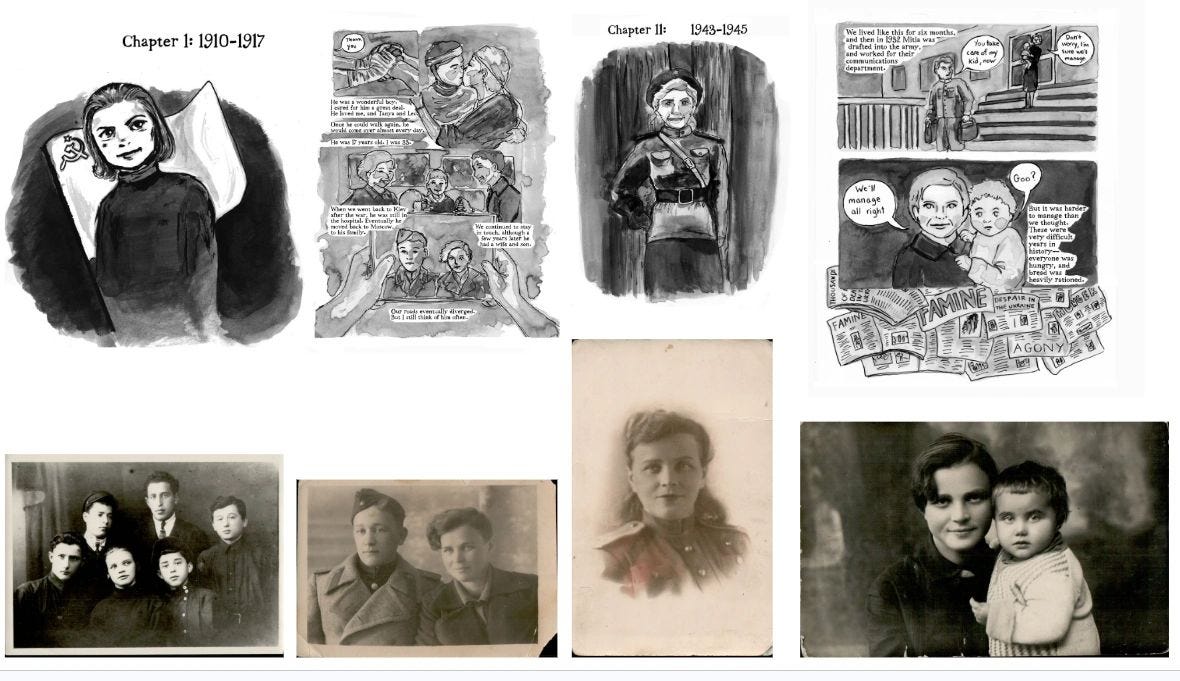
Julia’s influences lie far from superhero comics. Her work sits at the intersection of graphic memoir and early Soviet avant-garde culture. Her research into 1920s Soviet cinema—particularly the work of Dziga Vertov—shaped her visual approach. She also felt a deep connection to the poet Vladimir Mayakovsky.
In a moment of striking synchronicity, Julia discovered that Lola had titled her memoir after a Mayakovsky poem.
“It just took my breath away,” she said, “because he’s been a poet I’ve been really invested in emotionally for a long time.”
That connection helped bridge Lola’s revolutionary past with Julia’s own artistic sensibility.
Influences: Hillary Chute and R. Sikoryak
Julia’s extroversion proved to be an unexpected asset in what is often a solitary field. Rather than working in isolation, she actively sought out a creative community.
“I just asked everyone: ‘Do you know anyone working on comics? Can I talk to them?’”
Julia met comics scholar Hillary Chute while she was a PhD student at Harvard. At the time, her script focused almost entirely on Lola. Chute challenged her directly:
“This is great… but I keep thinking—what about you? Who is this person writing this?”
Julia initially resisted, worried it would feel “egotistical,” but ultimately realised that including herself created a bridge between generations, turning biography into a matrilineal dialogue.
A second turning point came when she met cartoonist R. Sikoryak at the MICE festival in Boston. After seeing her early experiments with ink and water, he said:
“It seems like you really enjoy doing this. Have you considered doing this for the entire book?”
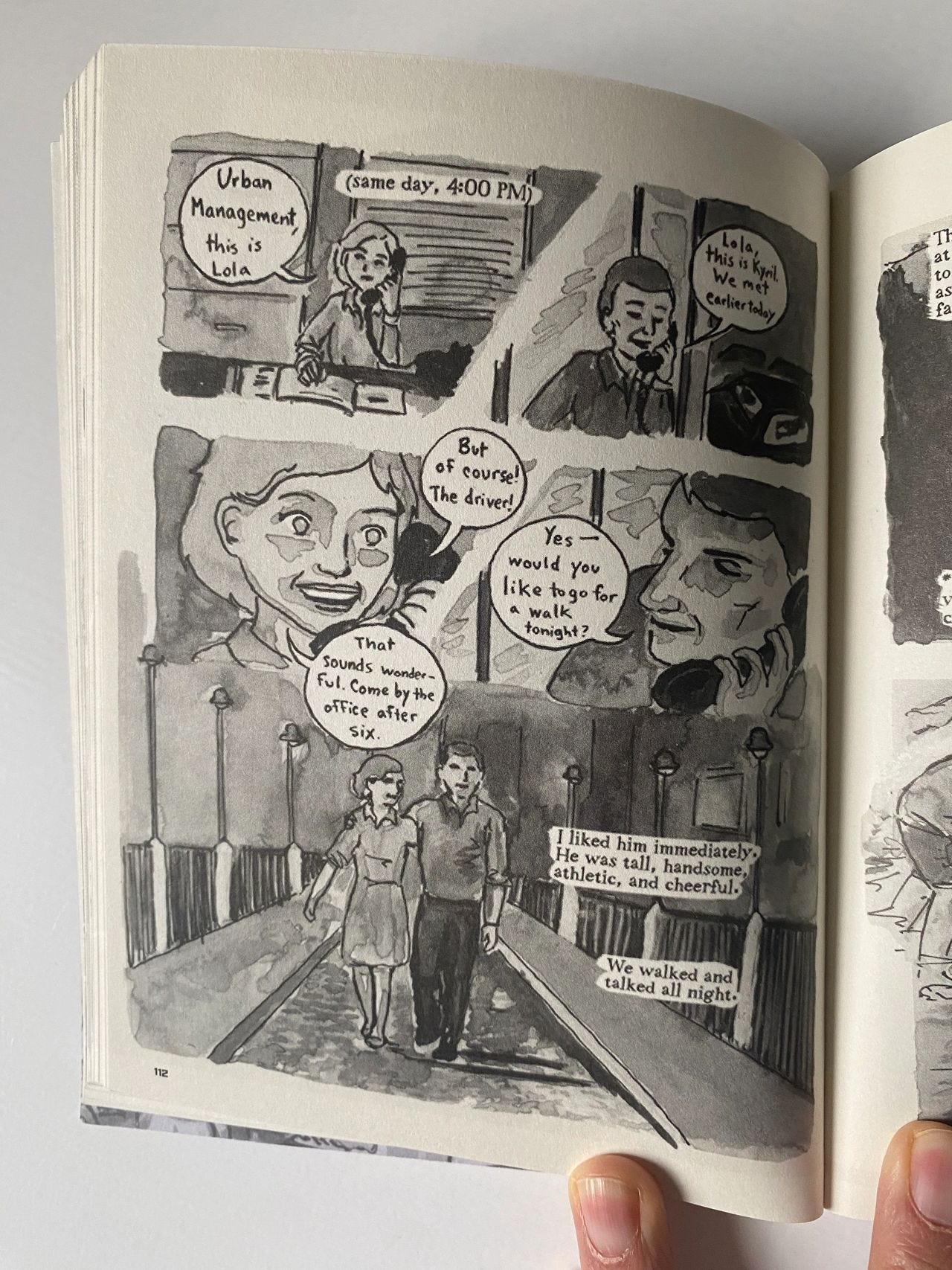
That single comment became decisive. It led her to abandon a standard comic line in favour of a textured ink-wash style that evokes aged, watermarked photographs.
The Artistic Process
For Julia, avoiding digital tools was a deliberate rejection of polish and control.
“I have never really liked using the tablet,” she admitted.
Instead, she committed to a fully tactile workflow: non-photo blue pencil on Bristol board, followed by unpredictable ink wash and hand finishing. Working at a disciplined pace of roughly one page per day, she treated the book as a physical labour practice as much as a creative one.
Even the text was handmade in spirit; she created a custom digital font based on her own “wonky typewriter” handwriting. The result is an archive that feels intentionally imperfect, mirroring the fragmented history it depicts.
The Journey to Publication
The path to publication was anything but smooth. Julia sent a sample chapter to fourteen publishers and heard nothing.
“I print it out, I make it look nice… and I don’t hear anything.”
So she changed strategy: finish the book first.
To fund the final stretch, she launched a Kickstarter campaign. “I ran out of money. I needed to make rent,” she recalled. The campaign’s success allowed her to produce mock-up copies.
A breakthrough came through a connection at The Strand Bookstore, which led her to Microcosm Publishing.
The final title, Soviet Daughter, was agreed with publisher Joe Biel. At one point, Communist Daughter was suggested, but Julia vetoed it for being too close to the Neutral Milk Hotel song Communist Daughter.
Reception and the Political Moment
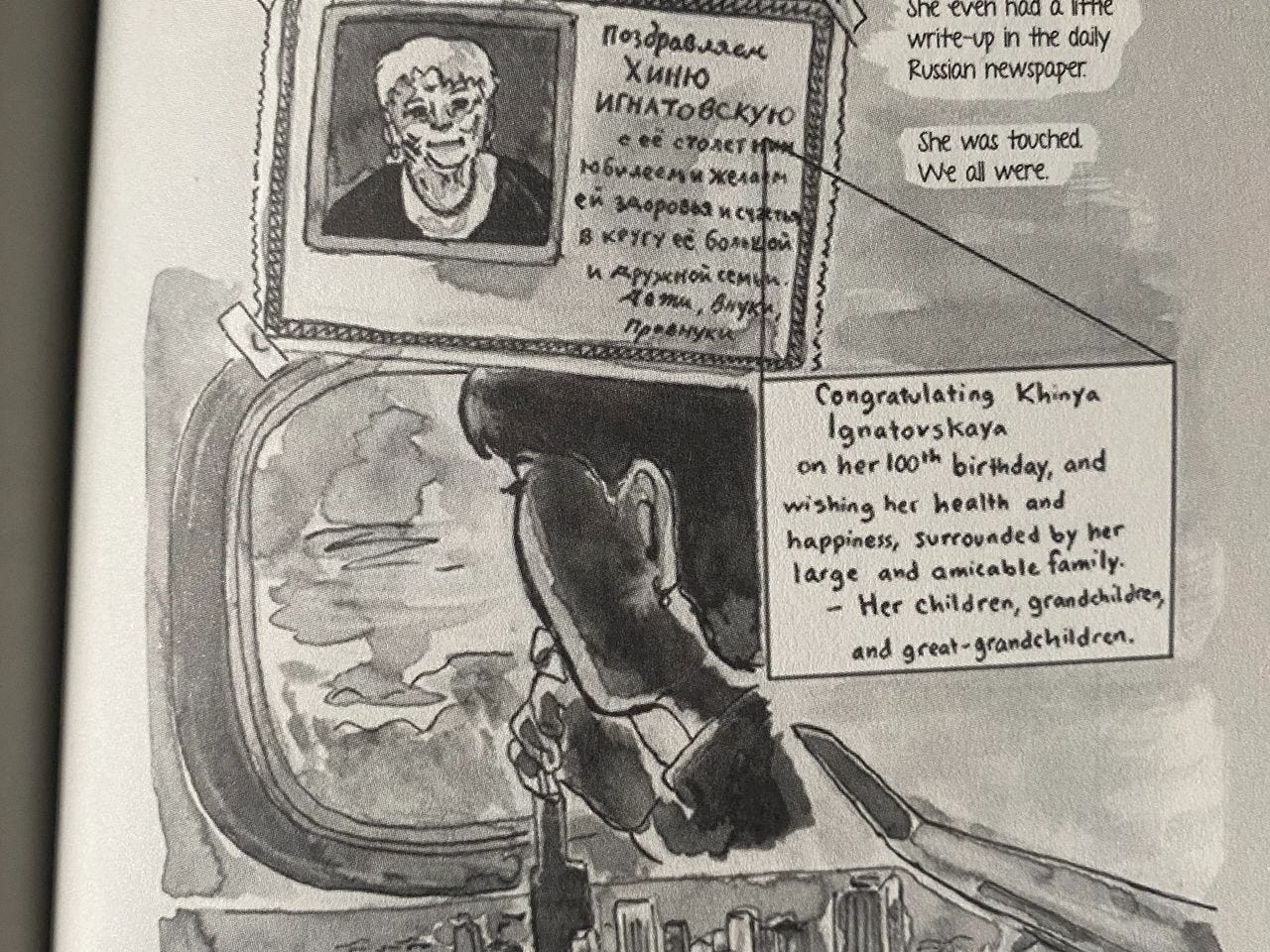
The initial reception was explosive, driven in part by an eight-minute feature on NPR, which Julia described as a “life dream.”
The book’s release in 2017 coincided with a shift in American political discourse. When Julia began the project, “socialist” was a word she felt she had to keep quiet. By publication, Bernie Sanders’ campaign had helped bring those conversations into the mainstream.
However, Julia noted that the Soviet story often failed to resonate with mainstream American Jewish audiences in the way she had hoped. She pointed to a cultural gap dating back to the 1990s, when American Jews sought to “save” Soviet Jews, only to encounter a sharp divide once they arrived.
“It was unfortunate,” Julia reflected. “I was seeing exactly the type of response that Soviet Jews tended to receive… as having no relation to their own experiences.”
That sense of distance reinforced for her the importance of what she sees as an act of “archival repair.”
Current Work and Legacy
Today, Julia works as an Assistant Professor at the University of Pennsylvania, continuing to bridge academia and art.
Her work sits within a small but influential network of contemporary memoirists, including Tessa Hulls and Sol Brager. She was in dialogue with Hulls during the development of Feeding Ghosts—only the second graphic novel ever to be nominated for a Pulitzer Prize after Maus—and contributed early material to Brager’s zine Doykeit.
“It’s cool for them to say things like, ‘Your book influenced me,’” she said. “I’m glad to be in community with that.”
Julia also spoke with admiration for Liana Finck, particularly A Bintel Brief: “It just made me cry. I am so influenced by that book; the drawing style especially really resonated with me.”
More recently, her focus has begun to shift from personal history toward global and ecological futures. During the pandemic, she began experiencing recurring dreams about the Arctic, which developed into a new project. For Julia, the Arctic has become both geographical and symbolic—a space of climate anxiety, fragility, and “end-times” thinking.
Across all her work, she remains committed to what she calls “archival repair”: using the tactile language of comics to make sense of inherited, often fractured histories, while extending that inquiry into uncertain futures.
Article written by Jonathan Sandler, author of the Graphic Novel, THE ENGLISH GI: WORLD WAR II GRAPHIC MEMOIR OF A YORKSHIRE SCHOOLBOY’S ADVENTURES IN THE UNITED STATES AND EUROPE, which was published in April 2022