

Towards a Radical Cosmopolitanism
Against ethnonationalism, qua Nandita Sharma, Mahmood Mamdani, and Mira Nair

In the 1991 film Mississippi Masala by Mira Nair (aka Zohran’s mom), an Indian family is forced to flee Uganda, where an ethnonationalist uprising has pronounced the country “fully African”— by which they mean, ethnically Ugandan, by which they mean, Black. No matter that the child protagonist (a gender swapped stand-in, perhaps, for Zohran himself, born around the time of the film’s European premiere) was born there, and that the family had lived there for about a century— brought in as cheap “coolie” labor from India by the same people who colonized much of the continent— because their roots were not autochthonous to the region, they were forced to flee.
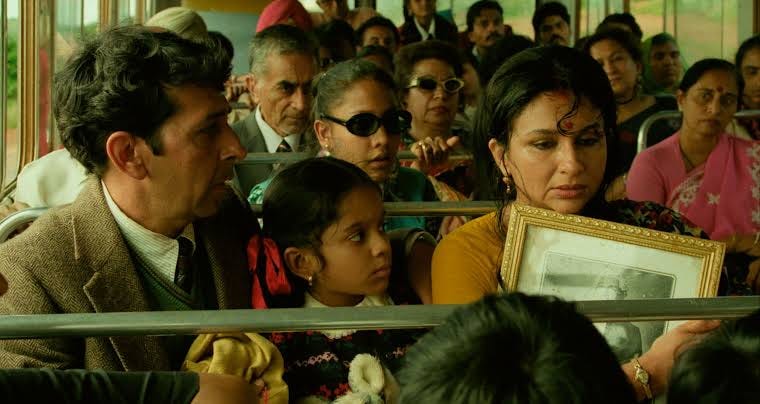

This narrative probably seems familiar, and it should; it happens pretty much every time a national liberation movement takes power. It is why racism increased in every country around the fall of the Soviet Union. It is why all the kids in my extraordinarily diverse K-8 school, off of Devon in Chicago, seemed to hate each other. It is also why the “___ for ___” chant always gave me pause, why the hair stood up on the back of my neck when the term “indigenous” (small i) was brought up in reference to any non-Native American (North or South) community.
The thing is, as a Soviet Jew I know full well I am not “from” anywhere. I cannot even lay claim to a shtetl (the culture of which has already been greatly exaggerated; in reality shtetl is just the word for village and they were never as homogenous as Fiddler on the Roof or Yentl made it seem). My family (parasitically, one could even argue) lived in and on the outskirts of Kyiv, which teetered in and out of the Pale of Settlement (the only regions where Jews are allowed to live) depending on the decade. Jews weren't allowed to own land so no one in my bloodline has ever tilled the soil. They were poor opportunists eking out a mere existence, “belonging” nowhere.
A few months ago, I read Home Rule by Nandita Sharma, a sociological text that, even with its flaws, seemed to embody the same deep-rooted suspicion of any solidarity based on race or ethnicity (especially my own). Fascinatingly, Sharma frequently cites Zohran’s father, Columbia political scientist Mahmood Mamdani. (Though he had a bit of a cult following amongst my undergrad friends in Comp Lit).
People who had been colonized, enslaved, and/or indentured together built maroon societies; people fighting against slavery asked, “Am I not a man and a brother?”; pirates freeing themselves from the sovereign power of ships’ captains sang, “All for one and one for all”; Diggers addressed each other as “fellow creatures”; women accused of speaking out of turn declared that “God was no respecter of faces”; and many direct producers organized against capitalism under the banner of “Workers of the world, unite!” Each of these struggles to break the chains of servitude to states and capital was built on the mobile politics of solidarity. People’s shared experience of the terror of expropriation, exploitation, and oppression led to people’s shared resistance—and to shared subjectivities.
Tragically, their struggles were lost. The victors cemented their power by institutionalizing private property, expanding the capitalist mode of production, enhancing states’ power, and weaving an interlocking web of ranked hierarchies normalized by ideas of race, gender/sex, and nationhood. Their greatest victory was the fact that many people experiencing expropriation, exploitation, and oppression saw themselves through these ruling identifications instead of with other direct producers. The acceptance and intensification of the contemporary separation between National-Natives and Migrants is the latest manifestation of such relations of “define and rule” (Mamdani 2012).1
The general argument here is that a national liberation revolutionary victory is followed by a culling of population based on blood rather than solidarity. Even if the uprising itself is socialist in nature, if solidarity is formed between class struggle and ethnicity, “migrant” will be split from “National-Native,” who will eventually be forced out of the country.
Sharma gives numerous examples of countries who began issuing immigrant quotas, especially from non-white countries, after liberatory movements or eras of popular uprising. I was especially shocked to learn about Liberia, a country colonized by former slaves during the early years of Reconstruction America, who then, armed with North American capitalist and eugenicist values, ruled a quasi-apartheid state in which the whiter Black Americans exist/existed as hierarchical superiors of the natives, despite their shared “autochthonous” origins. (One can't help but think of another tiny Middle Eastern country operating, in an extreme and far more visible fashion, largely along these same lines).
I was reminded of a book event for Alberto Toscano’s Late Fascism at Making Worlds (RIP) in Philly in 2024, with local (and controversial) leftist public intellectual Geo Maher. It was just a few months after Oct 7, 2023, and discussion of indigeneity in Palestine was de rigueur. I was a little perplexed about Maher and Toscano’s seemingly uncritical embrace of revolutionary nationalism. Surely any nationalism should be questioned, revolutionary or others? I commented about my own discomfort of ethnic determinism of any kind. Are leftists, I wondered, engaging in the same eugenicist race science about certain people being inherently better at, say, gardening or agriculture? Cannot the concept of embodied, ancestral knowledge— specifically, a (unpracticed, nebulous and biologically determined) knowledge that emphasizes a dubious epigenetic link based on bloodline— be questioned, especially when it comes to nation-building?
In Sharma’s book, the term “autochthonous” is used rather than “indigenous” to refer to people who are “of” a place— or rather, who are perceived to be from a place. In reality, of course, people may not be “of” a place for more than a few generations (any non-Indigenous Americans, for instance). The Red Star Line Museum in Antwerp in Belgium, one of my favorite museums in the country, argues that everyone (if you look back far enough) is an immigrant. The museum displays information about the company of the ship that carried Europeans to Ellis Island, the Red Star. The museum brings patrons through the intimate experiences of several of 2 million people who walked through the same doors with barely a suitcase, but I was even more touched by the introductory exhibit: a timeline of human migrations throughout history, from millions of years ago to the present day. Migration is a part of our species since its very beginning.


Still, however, the idea that people are inherently “from” one place and not several continues to be endemic to culture, including in leftism. In the last few months, I've noticed a kind of relaxing of these rigid rules, which brought me to finally write these words today, despite first wanting to write this post as far back as December. Of course my own beliefs are informed by my own background, my own forced belonging-nowhere, and my hope to universalize the Yiddish philosophy of doykeit, or hereness: where we are now, we belong. Instead, in far too many liberatory movements, racism emerges from the same movements that claim to fight it.
In the conclusion to her book, Sharma describes this as “postcolonial racism”::
It is best to call this form of racism postcolonial racism, because it depended on ideas of distinct and separate “national cultures,” each with its own territorial claims. The 1955 International Court of Justice ruling in the Nottebohm case established the international jurisprudence for the distinction between formal Nationals and “true” Nationals by arguing that “nationality is a legal bond having as its basis a social fact of attachment, a genuine connection of existence, interest and sentiments, together with the existence of reciprocal rights and duties” (in Batchelor 1998, 159–160). This became known as the legal principle of effective nationality: that formal citizenship in a nation-state is insufficient for an individual to be considered a National of it. Instead, a National must prove a meaningful connection to a state in which he or she is a citizen. Informed and mobilized by such nationalist geographies, in the Postcolonial New World Order, nation-states’ territories thus became “a space for each race” (Cohen 1997, 75). Postcolonial racism, thus, harnessed previous autochthonizing practices of “define and rule.” Nationhood became the new racist typology and Nationals the new “superior race.”2
It is a controversial argument, and fundamentally against the majority of movements who call themselves postcolonial. She argues for a decolonial, rather than postcolonial, liberation, which I tend to agree with even if I don't really share her ire against the postcolonial moniker itself. But where I get even more inspired is when she begins to imagine a future built not on nationalist nation-states but solidarities— when she begins to reject the nation itself:
Yet, until we take into account what we have lost by demanding sovereignty for National-Natives and recognize what we have lost by centering on the glory of the “nation” instead of the glory of the world’s builders, we will not realize decolonization. This book, then, is not a lament for imperialism; it is a dirge for nationalism. Only after the death of the national liberation project can we renew our commitment to decolonization.3
And:
Donald Trump (2015) understood this well on the campaign trail when he stated, “A nation without borders is not a nation at all. We must have a wall.” Nation-states are wholly reliant on the existence of citizenship and immigration controls. Trump uttered this to exalt the nation and normalize its border-making practices. However, we can turn his message on its head. “No borders” leads to “no nations”—and this, I argue, is a good thing indeed. From the start, migrants have been the specter haunting postcolonialism. Migrants do pose a particular kind of existential danger to the idea of national sovereignty and it is this: the very fact of people’s mobility calls into question the organization—and segregation—of the world into discrete, demarcated zones of national belonging. 4
What would this look like in practice, I wondered? I frequently think about what “no borders” really looks like— when every individual liberation-minded person on this planet begins to (re)consider what should “allow” a human to live anywhere. This is especially important in an era of climate collapse, when most studies believe that equatorial regions, and those near oceans, will face catastrophic harms, and billions will flee towards the polar regions— Alaska, Patagonia, Scandinavia, Siberia, Scotland, Iceland, and the Great Lakes.5 What if we started imagining a radical cosmopolitanism— a word whose original Greek etymology meant “citizen of the world”? In a universe that has always been, and will continue to be, in flux, ideological flexibility with regard to home and belonging will serve us well as a species. It is something Mira Nair’s romance film teaches us, as the two lovers, played by Denzel Washington and Sarita Choudhury, drive into the sunset. Mahmood Mamdani and Nandita Sharma describe it too. By giving it a name, and opening up an avenue for such imagining, I hope to coax it, however slowly, into being.
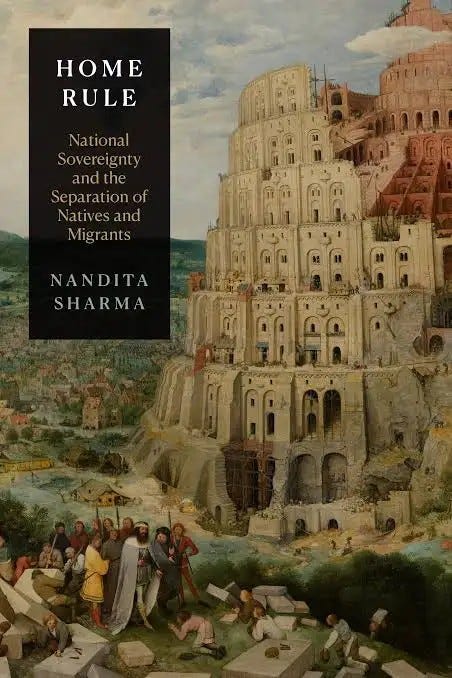
Nandita Sharma, Home Rule: National Sovereignty and the Separation of Natives and Migrants (Durham, NC: Duke University Press, 2020), 35.
Ibid., 279.
Ibid., 276.
Ibid., 278.
https://time.com/6209432/climate-change-where-we-will-live/